You Don't Need an Operations Manual. You Need a Starting Point.
In this post:
You're Not Behind — You're Just Winging It {#not-behind}
What an SOP Actually Is {#what-is-sop}
Start With One Thing {#start-with-one}
A Simple SOP Framework {#framework}
The Rule That Changes Everything {#the-rule}
Where to Go From Here {#where-next}
You're Not Behind — You're Just Winging It {#not-behind}
If you're running a small or medium-sized business and you don't have documented systems, you're not failing. You're just doing what most business owners do — keeping everything in your head and figuring it out as you go.
That works. Until it doesn't.
It doesn't work when you hire someone and realize you have no idea how to explain what you actually do. It doesn't work when you want to take a week off and find out the business can't run without you. It doesn't work when something breaks and you have to solve the same problem for the fifth time because nobody wrote down how to fix it the first time.
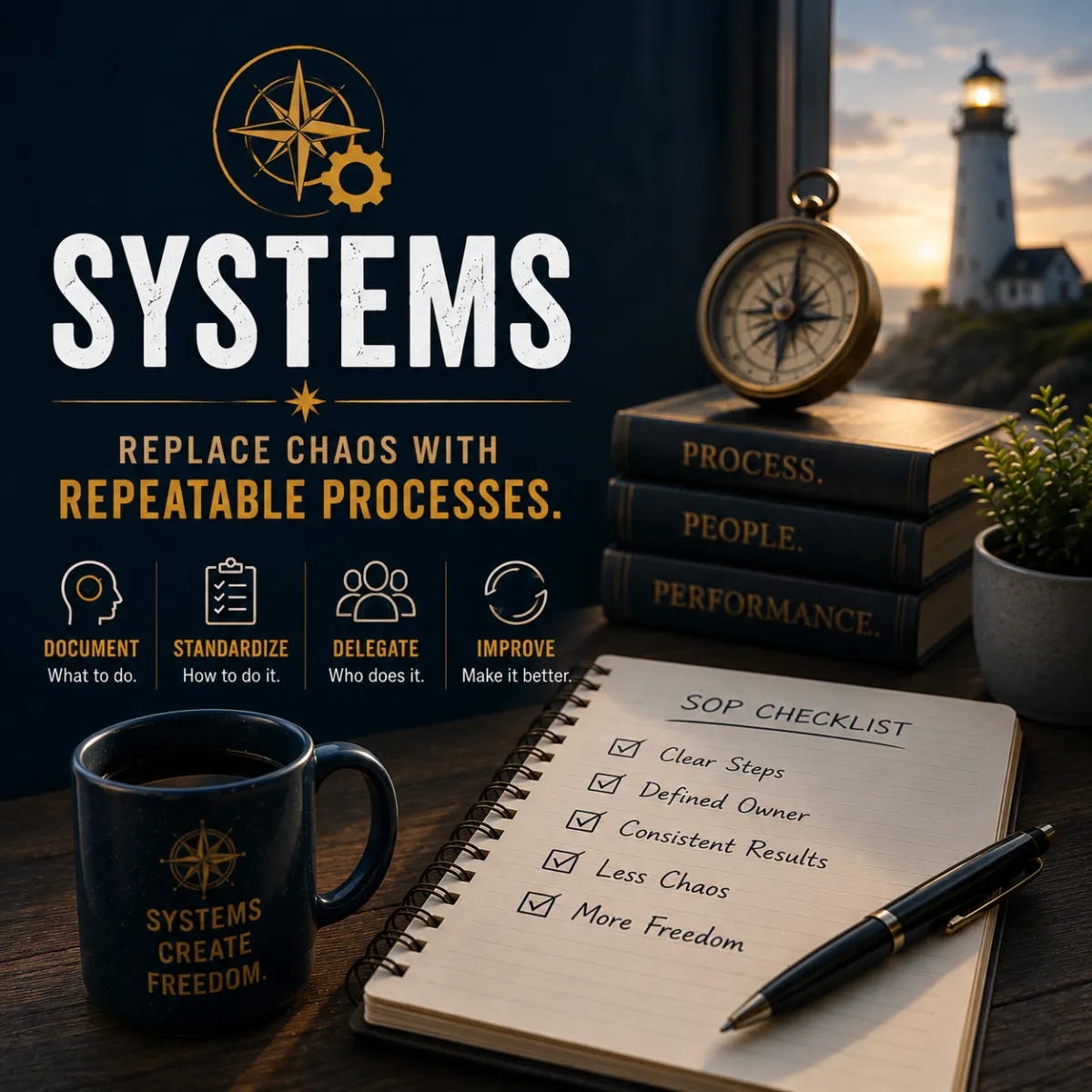
SOPs — Standard Operating Procedures — sound corporate and complicated. They're not. At their core, an SOP is just a written answer to the question: "How do we do this?"
That's it. Nothing more complicated than that.
The goal isn't a binder full of policies. The goal is getting the knowledge out of your head and into a format that someone else — or future you — can follow.
What an SOP Actually Is {#what-is-sop}
An SOP is a documented process for doing a specific task the right way, consistently.
Not a mission statement. Not a policy document. Not a company handbook.
A process. Step by step. Written down.
It can live in a Google Doc, a Notion page, a Word file, or even a voice memo transcribed into text. The format doesn't matter. What matters is that it exists somewhere outside your head.
A good SOP answers three questions:
What is this process for?
Who does it?
What are the steps, in order?
That's the whole thing. If you can answer those three questions for any task in your business, you have an SOP.
Start With One Thing {#start-with-one}
The biggest mistake business owners make with systems is trying to document everything at once. They buy a course, download a template, spend a weekend building a "systems library" — and then burn out before finishing a single usable document.
Don't do that.
Start with one thing. Pick the task in your business that causes the most friction — the thing you explain over and over, the thing that gets done differently every time, the thing that falls apart when you're not watching.
Write down how to do it. Step by step. Don't overthink the format. Just write it like you're explaining it to a capable adult who has never done it before.
That document is your first SOP. It took you twenty minutes. It will save you hours.
Do it again next week. And the week after. In three months you'll have a dozen processes documented and a business that runs a little more like a business and a little less like controlled chaos.
A Simple SOP Framework {#framework}
When you sit down to write an SOP, use this structure:
Title — What is this process called? Be specific. "How to Onboard a New Client" is better than "Onboarding."
Purpose — One sentence explaining why this process exists. "This ensures every new client receives a consistent welcome experience and has their account set up correctly before their first call."
Who does this — Which role or person is responsible for completing this process?
When it happens — What triggers this process? A new sale, a specific day of the week, a customer complaint?
Steps — Numbered, in order. Each step should be a single action. If a step has sub-steps, break it down further. If a step requires a tool or resource, name it.
Notes — Anything that doesn't fit neatly into the steps. Common mistakes, exceptions, links to related documents.
That's your template. Copy it, fill it in, repeat.
The Rule That Changes Everything {#the-rule}
Here's the mindset shift that makes systems stick:
If you do it more than twice, write it down.
Every time you answer the same question twice, you've identified a process that needs documentation. Every time you fix the same problem twice, you've found a gap in your systems. Every time you explain the same task twice, you've discovered an SOP that doesn't exist yet.
Most business owners treat repetition as normal. It's not normal — it's expensive. Every repeated explanation, every re-solved problem, every re-invented wheel costs you time you don't have.
Write it down once. Do it right every time after that.
Where to Go From Here {#where-next}
Once you have a handful of SOPs documented, the next step is connecting them into a system — a sequence of processes that runs predictably without you having to manage every step manually.
That's where automation comes in. When your processes are documented, you can start identifying which steps can be handled by software, which steps can be delegated, and which steps genuinely need your attention. That distinction is what creates freedom in a business.
But you can't automate what isn't documented. You can't delegate what only exists in your head. The SOP is the foundation everything else is built on.
Start with one. Write it down. The rest follows.
If you're working on building systems in your business and want to talk through what that looks like in practice, reach out and let's have a conversation. No pitch — just a straightforward conversation about where you are and where you want to be.